
This is the second hike in excise duty in less than two weeks as the government looks to make use of the slump in oil prices to shore up resources.

The rupee fell 23 paise against the greenback to settle at a new all-time low of 91.01 (provisional) on Tuesday, weighed down by relentless foreign fund outflows, no breakthrough in India-US trade deal, and persistent US dollar buying.

India's sugar consumption is projected to fall by nearly 400,000 tonnes in the 2025-26 season, primarily due to the ongoing liquefied petroleum gas (LPG) shortage exacerbated by the West Asia conflict and unseasonably cool weather.

Foreign Portfolio Investors (FPIs) withdrew nearly Rs 33,000 crore from Indian equities in May, bringing the total outflow for 2026 to Rs 2.25 lakh crore, driven by weak earnings growth, rupee depreciation, and more attractive opportunities in other global markets.

Indian rice exporters are seeking urgent government support to mitigate the impact of shipping disruptions caused by the Iran crisis and instability in key maritime routes. The disruptions have led to increased freight rates, insurance premiums, and fuel costs, impacting domestic prices and exporter profitability.

New demat account additions in India reached an 11-month low in March, with only 2.15 million new accounts opened, significantly below the 12-month average. This slowdown is attributed to a sharp decline in equity markets, escalating West Asia tensions, and increased crude oil prices impacting India's economic outlook.

The falls meant that both crude futures were at their lowest levels since mid-April

Households should moderate large discretionary expenses for the time being.
'They should prioritise essential spending. They should maintain an emergency fund covering 6 to 12 months of expenses.'
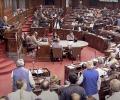
Opposition MPs in the Rajya Sabha criticised the Modi government's economic policies, citing the LPG crisis, lack of energy security, and concerns over the Economic Stabilisation Fund.

Indian stock markets recovered from early losses to close higher, driven by value buying in IT and banking shares and a rebound in the rupee.

As the rupee has been on a downward slide and crossed 90 a dollar, consumer electronics firms are looking to raise prices of products ranging from air conditioners (ACs) to television panels up to 10 per cent.

Benchmark equity indices Sensex and Nifty tumbled in early trade on Wednesday, tracking a bearish trend in Asian markets, as the conflict in West Asia widened, driving oil prices higher.

Years of repression and disappearances have taught Venezuelans, the hard way, not to voice either their anger or their joy, observes Radha Roy Biswas who spent her formative years in Venezuela.

Wholesale price inflation dropped to 0.85 per cent in April as prices of food articles, manufactured products, and fuel eased, government data showed on Wednesday. WPI-based inflation was 2.05 per cent in March. It was 1.19 per cent in April last year.

Farmers in the Indian state of Rajasthan are rediscovering the humble camel.

India's trade deficit shrank to a 10-month low in December as global oil prices tumbled and demand for gold fell, auguring well for Indian current account balance and the rupee.

The benchmark BSE Sensex's trailing 12-month price-to-earnings (P/E) multiple has declined to 20.2x, its lowest since May 2020, driven by a record $42 billion FPI selloff since September 2024 and concerns over corporate earnings and economic growth.

'Strikes into the Gulf countries are proof that the security guarantees offered by the US are ineffective and that the Gulf countries cannot rely on American security assurances for their safety.'

Indian equities on Dalal Street saw volatility as global market trends and fresh tariff concerns linked to Donald Trump impacted investor sentiment. Track Sensex, Nifty50 movement and key market drivers for Feb 24, 2026.
Equity benchmark indices Sensex and Nifty experienced a significant decline, primarily driven by a selloff in IT stocks due to concerns about AI disruption and renewed worries over global trade.

The Indian government has increased import duties on gold and silver from 6 per cent to 15 per cent to curb inbound shipments of precious metals amid a rising import bill due to the West Asia crisis.

India's core sector output contracted by 0.4 per cent in March, marking the first decline in five months, with coal, crude oil, fertiliser, and electricity production falling, according to official data.

Fixed deposits from nationalised banks delivered higher returns than equities, outperforming both inflation and stock market benchmarks.

Foreign Portfolio Investors (FPIs) have withdrawn over Rs 62,853 crore from Indian equities in the first fortnight of June, bringing the total outflows for 2026 to Rs 2.87 lakh crore, surpassing the entire 2025 figure, driven by geopolitical tensions, global economic growth concerns, and a weakening rupee.

After registering a positive growth for two months, India's exports slipped into negative territory again, contracting 2.17 per cent year-on-year to $38.73 billion in May due to a fall in global petroleum prices, while trade deficit narrowed at $21.88 billion during the month.

The core issues to be settled -- access to Hormuz, Israel's aggression in Lebanon, the question of Iran's nuclear programme, sanctions relief and compensation -- are thorny enough to require weeks of patient negotiation. The most likely outcome of the opening sessions is that both sides take the measure of each other, establish what is and is not negotiable, and return home without having broken anything. That would count as progress.
International oil prices continue to be extremely volatile, falling on one day and rising thereafter, a top oil ministry official said explaining the reason behind no reduction in petrol and diesel prices despite softening in input cost, but could not say if the rates will be cut before Maharashtra elections. Global oil benchmark Brent crude futures fell below $70 per barrel last week -- the first time since December 2021 -- but gained thereafter. Brent was trading at $74.58 per barrel on Thursday while West Texas Intermediate advanced to trade at $71.71.

The BSE Sensex and the Nifty 50 declined around 4.5 per cent each since the start of the West Asia conflict.

'Our diplomacy should have been focused on preventing war and avoiding the inevitable disruptions it would cause, posing a real risk to India's growth story,' asserts former foreign secretary Shyam Saran.

Leading FMCG companies have announced a price cut on their products, including soaps, shampoo, baby diapers, toothpaste, razors, and after-shave lotions, effective from September 22 to extend the GST rate cut benefits to consumers. Firms such as Procter & Gamble, Emami and HUL have come up with new price lists which have been communicated to their respective distributors and consumers through their respective websites.

'The market's nervousness ahead of anticipated US tariffs has led to a significant downturn in Indian equities.'

The United States, which entered this war in expectation of a short, sharp win along the Venezuela model, is now preparing for deeper involvement in a conflict it does not fully control, without the allies it typically relies on, against an adversary that is not behaving as expected, in a global environment that is already absorbing economic shock. Prem Panicker continues his must read daily blog on the Gulf War.

Reserve Bank of India (RBI) Governor Sanjay Malhotra stated that recent regulatory measures to address foreign exchange market volatility, such as capping banks' net open positions, are temporary and aligned with current market conditions, not signalling any structural shift in policy.

10 stocks from the Nifty 200 index that offer good growth potential and scope to deliver decent returns from current levels, based on brokerage estimates.

'Once the market decides it wants to go up, it goes up -- no amount of bad news can really hold it back.'
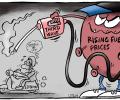
A surge in international oil prices may translate into an increase in the retail selling price of petrol and diesel in India as oil companies face extreme margin squeeze, sources said. Petrol and diesel prices have remained unchanged for 12 days but now the international rate surge is exerting pressure. Current prices of petrol and diesel in the international market are higher by around $4-6 per barrel as compared to average prices during August. However, no increase in retail prices has been affected by oil companies so far, sources said.

Sensex sinks 573 pts on global tensions and high crude prices

Corporate margins and profits in India remain vulnerable to changes in crude oil prices in the international market. Historical quarterly data from listed companies (excluding banks, finance and insurance, oil and gas, and power sectors) indicate an adverse correlation between corporate margins and crude oil prices.

As the rupee weakens, wealthy families are accelerating investments in global assets.

India's trade with West Asia saw a significant decline of over 28% in April, marking the second consecutive month of contraction. This downturn is attributed to severe shipping disruptions stemming from the ongoing conflict involving the US, Israel, and Iran, particularly impacting the crucial Strait of Hormuz waterway.
